


ASHFORD DISTRICT
Religious Buildings & Areas
Some ghost members are said to be haunting the halls of ancient religious buildings and graveyards with their stories to tell, whether it is residual energy or Spirit.
Here is what has been found so far in the Ashford District...
Trespassing remains to be considered for those seeking to visit a cemetery at night.
Private graveyards are off-limits unless you have the owners' permission. However, even cemeteries that are open to the public have guidelines that visitors ought to follow.
From listing their visiting hours online and in their offices to physically closing their gates, most cemeteries make it clear when visitors are welcome and when they aren't. In other words, it should be easy to tell when you're trespassing, even on so-called "public" burial sites. (And, it bears mentioning, if you find yourself hopping a fence or wondering whether what you're doing counts as trespassing, there's a good chance it does.) Either contact the cemetery's owner or caretaker to discuss visiting at night.
CLICK ON THE PICTURE FOR THE BUSINESS WEBSITE
If you find any missing information, hear of any reports of Paranormal Activity, have a story to share about any of the listed places that aren't reported here, or know of any that are not mentioned, please get in touch. Thank you.

ST AUGUSTINES PRIORY
BILSINGTON, ASHFORD TN25
**HISTORY**
Sometimes known as Bilsington priory, this medieval priory is rich in history. It was founded in 1253 and originally served as the home for the Black Canons of St. Augustine's Order. The priory also functioned as a hostel for many pilgrims travelling to Canterbury.
During the Dissolution of the Monasteries, the priory was suppressed, and ownership transferred to Thomas Cranmer, Archbishop of Canterbury. Most of the monastery was demolished, and the surviving buildings were repurposed as farmhouses throughout the post-medieval period.
In the early 19th century, local smugglers known as the Aldington Gang used the monastic buildings to store contraband, leading to gradual decay. In 1906, the buildings were restored based on the designs of J.T. Micklethwaite and were granted their first Grade I listing in October 1952.
Today, the priory serves as a wedding and conference venue, set in seven magnificent acres of mature gardens within a private estate. It still retains its ancient tradition of offering hospitality to the Archdeacon of Canterbury, who has the privilege of staying at the priory for two nights and a day, but no longer. The venue also hosts paranormal events.
**PARANORMAL ACTIVITY**
The remains of the priory are said to be haunted by Augustinian monks who once worshipped there. Many years ago, Mr. and Mrs. Joseph Conrad drove in their pony and trap one autumn evening when the pony cast a shoe, forcing them to stop near Bilsington Priory. Mrs Conrad had a first-hand experience with the apparitions; she saw a long procession of monks in habits, slowly passing along a hidden flight of steps, their wooden sandals making ghostly sounds as they climbed.
During an advertised event in the summer of 2017, a séance occurred on the tower's upper floor when heavy footsteps were heard climbing the stone staircase leading to the room. Marc Weston, a paranormal researcher, assumed it was one of the property owners involved in other activities during the event. However, upon checking at the top of the stairs, he found no one; all team members and guests were accounted for. Was it the spirit of an old smuggler checking on hidden loot?
Later in the evening, while in the chapel area, similar noises were heard again, this time coming from the main staircase that led from the entrance hall to the first floor. A small group of guests gathered at the head of the stairs, and the camera system indicated that two figures were moving just a few feet away. Suddenly, an elderly male guest shouted and collapsed to the floor, claiming he had been punched from behind and kicked in the calf, causing him to kneel in shock.
Their geoportal box also yielded several intriguing responses, and digital recordings captured frantic knocking sounds, suggesting poltergeist activity. The surrounding grounds provided unsettling sensations allegedly associated with a female who drowned in the adjacent pond, leading guests and investigators alike to feel reluctant to venture into that area alone.
Marc Weston's final assessment was that all in all, this is a venue with definite activity, responsible for an unusually high amount of EVP on every occasion I have had the opportunity to investigate here. A return to the venue is imminent, and we all look forward to experiencing even more paranormal activity."
Group events are sometimes available, so check out the Events in Kent page if you are interested in an investigation. I attended an investigation there, but unfortunately, nothing unusual happened during our visit; it seemed very quiet.
You can watch past paranormal events, visitors' experiences, evidence and activities on the GofEPS YouTube playlist HERE

ST MARYS CHURCH
EASTWELL, ASHFORD, KENT TN25
**HISTORY**
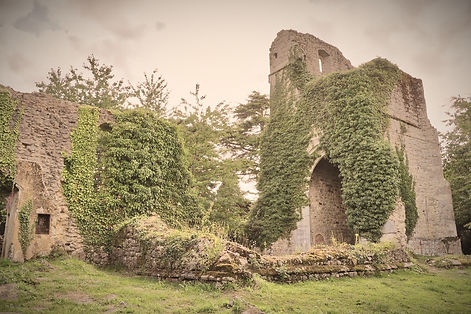
The 14th-century Church Ruins of St. Mary's are located on the grounds of Eastwell Park. While the church is predominantly a ruin, the 15th-century tower and the 19th-century southwest chapel still stand. The chapel once housed a monument to the Countess of Winchilsea, which has since been relocated to the Victoria and Albert Museum.
There is a memorial to a Richard Plantagenet in the churchyard, which some believe to be Richard III's illegitimate son, more information on that HERE
George Finch-Hatton, the 11th Earl of Winchilsea (1815–1887), along with his second wife, Lady Elizabeth Georgiana (d. 1904, daughter of Francis Conyngham, 2nd Marquess Conyngham), and their only son, George William Finch-Hatton, Viscount Maidstone (1852–1879), are buried in a simple grave in the church cemetery.
During the Second World War, the army utilized the Eastwell Estate for tank training and military practice. This activity is said to have weakened the church, with significant damage occurring in early 1943 when blasting during training caused plaster to fall and doors to burst open from pressure waves. These issues persisted, but repairs were not prioritized to prevent potential worker injuries. Subsequently, notices were posted stating, "Keep out. You may be killed."
A sentry was stationed at the top of the lane leading to the church, turning away anyone attempting to enter. Due to the area's secretive nature, the entire location was closed to the public. The police and military cooperated in the burials of the deceased, and gravediggers and the burial party received military escorts.
An artificial lake, created in the 1840s by damming a tributary stream of the River Great Stour, is said to have caused seepage into the church's chalk foundations.
The nave roof collapsed in 1951, and the remaining structure of the church was demolished in 1956, leaving only the footings, the tower, and the 19th-century mortuary chapel. It is designated as a scheduled ancient monument and was listed as Grade II in November 1957.
The Friends of Friendless Churches took responsibility for the site in 1980. They replaced unsightly brick infill, designed to deter vandals, with a durable iron screen. There is no internal access to the church, and the grounds are consecrated, with many old graves still present.
**PARANORMAL ACTIVITY**
The site is said to be haunted by the ghost of a monk, and various groups have recorded electronic voice phenomena (EVPs) of unexplained occurrences. Ghost Connections and other organizations have conducted investigations at the site. The GofEPS Pinterest board for Eastwell available HERE, links to a Ghost Connections report on one of their visits and other articles and videos.
You can watch past paranormal events, visitors' experiences, evidence and activities on the GofEPS YouTube playlist HERE.
ST MARYS CHURCH (RUINS)
PLUCKLEY ROAD, LITTLE CHART, KENT, TN23
**HISTORY**
This medieval parish church was built by the Normans in the 11th century as a two-cell structure and has since expanded. It is dedicated to Saint Mary the Virgin and the Holy Rood and is described as a handsome building made of sandstone, featuring two aisles, two chancels, and a steeple at the west end.
The land remained under the possession of the Archbishop of Canterbury until the reign of Henry VIII, who dissolved all monasteries between 1536 and 1539. He confiscated the Great Chart and its lands from the priory but later reinstated them to his new Protestant Dean and Chapter. The steeple is believed to have been constructed during Henry VII's reign. Significant repairs were made in the 19th century by the Victorians, who added new windows and oak paneling.
On August 16, 1944, during World War II, St. Mary's suffered a direct hit from a flying bomb, commonly known as a doodlebug. Only the damaged tower and parts of the chancel wall survived the attack, and the bells were removed for safekeeping. In 1955, a new church was built closer to the village.
**PARANORMAL ACTIVITY**
In the graveyard, there have been several reported sightings of mist on clear days, groups of people in the distance, and unexplained sounds coming from the tower.
A legend speaks of a large phantom bull that appeared within the church during a thunderstorm, causing panic and supposedly injuring or killing several people as it stampeded and knocked down part of a wall.
I have conducted an investigation at this site and captured some EVPs.
You can watch previous paranormal events, visitor experiences, and evidence on the GofEPS YouTube playlist HERE.

ST NICHOLAS CHURCH
PLUCKLEY, ASHFORD TN27
**HISTORY**
St. Nicholas' Church, nestled in the picturesque heart of the village and adjacent to the notoriously haunted 'Black Horse' public house, is believed to have been constructed on the site of an even earlier Saxon church. The name "Pluckley" traces its roots back to the Saxon era, with historical records from the Monks of Canterbury indicating the presence of a church in this location as early as 1090. Interestingly, the structural remnants found in the northwest wall are thought to date back to the Norman period, showcasing layers of history within its stones.
By the 13th century, a stone church had been erected that closely matches the length of the current building, with the striking spire likely added during the 15th century, giving the edifice its distinct silhouette against the village backdrop. Inside the chancel, visitors will discover a piscina—an intricately designed basin for ceremonial washing—and double sedilia, which served as seating for the priests of Pluckley and its neighboring parish of Pennington.
The church's historical narrative was not without disruption, as its beautiful stained-glass windows suffered damage during the bombings of the Second World War. Thankfully, in 1954, two of these windows were lovingly restored with exquisite new stained glass that breathes life into the church's interior.
**PARANORMAL ACTIVITY**
The churchyard is steeped in legend, haunted by the sorrowful specter known as the "Red Lady." Witnesses frequently recount encounters with her as she wanders among the graves, her ethereal figure searching mournfully for her unchristened baby. Nighttime investigations reveal the eerie sounds of knocking emanating from beneath the church, occasionally accompanied by flickering lights that dance within the otherwise empty building. Many believe these lights belong to Lady Dering, who lies interred in three lead coffins, a precaution taken to prevent her decay. Additionally, the interior of the church is said to be visited by the apparition of a woman clad in mid-20th-century clothing, adding layers to the church's haunting history.Having conducted numerous investigations within the graveyard, I have captured some intriguing EVPs (electronic voice phenomena) that hint at the church's otherworldly presence. For those interested in delving deeper into past paranormal events, visitor experiences, and glimpses of captured evidence, you can explore the GofEPS YouTube playlist HERE.